
Losing moral control in Iraq
The Army saw its job as establishing physical authority in Iraq. It failed to do this because Rumsfeld, Franks, and other leaders overruled Army decisionmaking. The first days of the occupation were a critical period for establishing law and order, but the early windows of opportunity were all missed, because the army's command and control structure was overruled by the Pentagon brat pack.
There is a parallel story, which is how America lost moral control of Iraq. America's moral authority was supposed to make up for the shortage of troops. The Bush Gang didn't plan for the insurgency because the Iraqis were going to be throwing flowers on our soldiers. Wolfowitz said, "I'm reasonably sure they will greet us as liberators, and that will help to keep the requirements down." So we were not going to need 400,000 troops because the Iraqis were going to be so happy about all the democracy and freedom and stuff, that they would just be standing around slack-jawed and grinning. This is the actual strategy which was sold to the American public.
So why didn't it happen? After all, our army liberated them from Saddam Hussein, and painted schools, and so on. Why aren't they happy? Let's start by looking at the polls.
August 2003 - Iraqis suspicious but friendly
In the beginning, Iraqis were, in fact, on the happy side. Three months into the occupation, half the respondents in a Bagdad poll said the US was "right" to start the war, 27% said "wrong" and 23% were undecided. More of them were friendly to Americans (26%) than hostile (18%), but 50% of them were "neither friendly nor hostile".
...only 13 per cent want the Americans and British troops to leave immediately. As many as 76 per cent want them to stay for the time being – with a majority, 56 per cent, wanting them to remain for at least 12 months.
The people in Bagdad were worried about public safety, electricity, clean water, and health:
...Asked to list the biggest day-to-day problems “affecting you personally”, an unsurprising 80 per cent mention power cuts and the lack of reliable electricity supplies.
More alarming is the 67 per cent who fear the danger of being attacked in the streets – a fear that afflict men and women in equal numbers. 50 per cent also fear being attacked at home or at work. Other widespread concerns include the lack of clean water, doctors and medical supplies....fully 75 per cent say Iraq is more dangerous than it was before the war
So, three months into the occupation, residents of Bagdad were mostly willing to go along with the occupation and give our soldiers the benefit of the doubt, but they felt unsafe in their persons and houses. They wanted utilities and personal security.
Reconstruction fails due to corruption
They didn't get electricity or sewage treatment, although plenty of money was spent on "disorder, negligence, and mismanagement". Using Iraqi money, cronies of the Bush gang paid themselves to fix up Iraq. You can read about war profiteering here.
... the CPA awarded U.S. firms 74 percent of the value of all contracts paid for with Iraqi funds. ... Iraqi firms, by contrast, received just 2 percent of the value of contracts paid for with Iraqi funds. "Government favorites such as Kellogg, Brown and Root benefited at the expense of Iraqi companies whose workers badly need jobs," [my italics]
The report finds that 60 percent of the value of all contracts paid with Iraqi funds went to Halliburton subsidiary Kellogg, Brown & Root (KBR)-the same company that Pentagon auditors in December 2003 found had overcharged the U.S. government for as much as $61 million for fuel imports into Iraq.
So the Iraqis first concern was to get lights, sewage, and hospitals. The money for this was given to American corporations, and the money disappeared.
From a military standpoint, reconstruction is central to the US counterinsurgency effort. The occupation's star officers, like Maj. Gen. David Petraeus, readily acknowledge that a broken economy means more violence. But seen up close, reconstruction in Iraq looks less like a ... sophisticated pacification program and more like a criminal racket.
...The Rustimiyah sewage plants ...daily flow of 780,000 cubic yards of human and industrial waste goes directly into the Diyala River, which joins the Tigris seven miles southwest of the plants. Rustimiyah South's director is Riyidh Numan, a hospitable and reflective engineer in his early 30s working for the Baghdad Sewage Authority. Since Bechtel took over a year ago, his job has mostly consisted of sitting around and waiting for the foreign contractors to execute the repairs. Numan says the first thing Bechtel did when it showed up was to start painting buildings. He demanded that they stop and switch to repairing the plant's primary functions. Since then work has been slow, and all Numan can do is complain to the Baghdad Sewage Authority, which in turn dispatches impotent letters to Bechtel.
This was in the early days, before the insurgency was such a problem that reconstruction money had to be diverted to private security companies. This is biological warfare, American style - letting people drink sewage and shit themselves to death. It is not just the theft of billions of dollars, it is a war crime.
At any rate, immediately after the war Iraqis wanted lights and sewage treatment. The occupation took the money from Iraq and from American taxpayers to pay for these things, but did not deliver.
The occupation does not provide security
The second thing that Iraqis wanted in the early days was personal security. They didn't get that either. Here is from a memo sent to Tony Blair during the first month of the occupation:
Our Paras company at the embassy witnessed a US tank respond to (harmless) Kalashnikov fire into the air from a block of residential flats by firing three tank rounds into the building. Stories are numerous of US troops sitting on tanks parked in front of public buildings while looters go about their business behind them. Every civilian who approaches a US checkpoint is treated as a potential suicide bomber.
This was before the poll in which 75% of Bagdad respondents said they felt less safe under the occupation than under Saddam Hussein. When asked about the looting, Rumsfeld brushed it off with a famous comment that "Freedom's untidy".
At that time, the insurgency did not yet include bombing attacks on civilians, but civilians were dying at the hands of U.S. troops. Here is from the 'shock and awe' campaign, before the ground invasion:
It was Rahad's turn to hide. The nine-year-old girl found a good place to conceal herself from her playmates, the game of hide and seek having lasted some two hours along a quiet residential street in the town of Fallujah, on the banks of the Euphrates. But while Rahad crouched behind the wall of a neighbour's house, someone else - not playing the game - had spotted her, and her friends; someone above. The pilot of an American A-10 'tank-buster' aircraft, hovering in a figure of eight...
The 'daisy-cutter' bounced and exploded a few feet above ground, blasting red-hot shrapnel into the walls not of a tank but of houses. Rahad Septi and 10 other children lost their lives; another 12 were injured. Three adults were also killed.
Juma Septi, father to Rahad, holds a photograph of his daughter in the palm of his hand as he recalls the afternoon he lost his 'little flower'. A carpenter, Septi had been a lifelong opponent of Saddam Hussein...
Here is from Nassiriyah, during the rush to Bagdad:
'The lights were on inside the bus,' remembers Sajed, 'and there was some shouting, American shouting. There was silence for a while, then a noise which made me think I would go deaf. The bus jumped like an animal being killed. Next day, the Americans came and buried the bodies of all the people, and the morning after that they came back and burned the bus.'
Rahad Klader, 30, who saw the incident from his window, recounts that after the tank had fired and the bus exploded, the Americans came up to the vehicle and emptied their machine-guns into whoever had survived. Ammunition strewn around the wreck is, indeed, American - not Iraqi, which would have given the tank some reason to suspect military activity aboard the bus.
Killing and abuse of civilians by American forces has continued. Here is from a March, 2006 interview with Ben Griffin, a member of the SAS (British Special Forces)
He said he had witnessed dozens of illegal acts by US fighters who viewed Iraqis as "sub-human". Mr Griffin said: "I saw a lot of things in Baghdad that were illegal or just wrong. The Americans were doing things like chucking farmers into Abu Ghraib, or handing them over to the Iraqi authorities, knowing full well they were going to be tortured."
There is a vast body of reporting and photography which documents the killing of civilians by American bombardment and American soldiers. So in the early days the occupation did not protect Iraqis from criminal elements and occupation forces directly killed large numbers of civilians. After a time, elements of the insurgency began bombing attacks on civilians. The occupation did not protect Iraqis from this threat as well.
Iraqi opinion turns against the occupation
The effect of all of these moral failures was the loss of Iraqi tolerance for the occupation. An ABC News/BBC poll in October 2005 found
50.3 per cent of Iraqis polled answered that the 2003 invasion was somewhat or absolutely wrong. That’s an increase from 39.1 per cent in a similar survey in March 2004
In January, 2006, a sample of 1,150 Iraqis found
Nearly half of Iraqis approve of attacks on U.S.-led forces - including nine out of 10 Sunnis. Most Iraqis believe that many aspects of their lives will improve once the U.S.-led forces leave...
A review of all of the polls taken in Iraq since the beginning of the war found that the occupation itself was the problem:
An examination of Iraqi public opinion data ... suggests that coalition military activity may be substantially contributing to Iraqi discontent and opposition.
...Public discontent is the water in which the insurgents swim. Polls show that a large majority of Iraqis have little faith in coalition troops and view them as occupiers, not liberators. There is significant support for attacks on foreign troops and a large majority of Iraqis want them to leave within a year.
... Ten percent of Iraqis report having had "very negative" encounters with coalition forces. Fifty-eight percent claim that US forces behave badly.
... there is a correlation between Iraqis' experiences of violence, negative appraisals of US troops, and support for insurgent attacks. The geographic pattern of coalition military activity corresponds with the distribution of these attitudes, which peak in Sunni areas and Baghdad.
... Polls in June 2004 showed that the chief reasons for the sharp negative turn in Iraqi opinion were (in order): Abu Ghraib, the Falluja attack, "bad" or violent behavior by troops, and the failure to provide security.
The loss of moral authority
It is well known that before the war, General Shinseki recommended more troops. Here is part of his statement:
- "It takes a significant ground force presence to maintain a safe and secure environment, to ensure that people are fed, that water is [distributed], all the normal responsibilities that go along with administering a situation like this."
Rumsfeld dismissed this in public and ridiculed it off the record. It was "bullshit from a Clintonite enamoured of using the army for peacekeeping and not winning wars". Here is what Iraqis got:
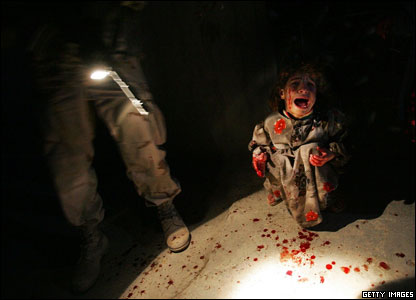
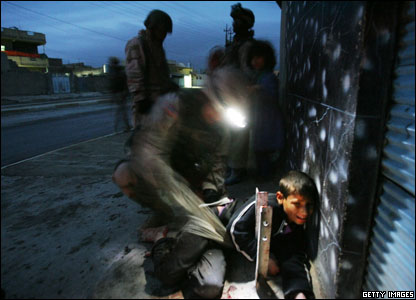
The troops in these pictures had just killed the kids' parents - a family in a car. Afterwards, the soldiers took the kids to a hospital.
These soldiers made a mistake. They made it because they were not trained for police work. They were working at one third the troop levels they needed. They didn't have enough translators or armor. They didn't have "intelligence". When their Generals asked for more troops, the Generals were threatened with firing. That's the kind of leadership these soldiers got. And they weren't even the actual victims.
The public strategy of the Bush Gang was to use America's moral authority, our role as "liberators", to make up for a shortage of troops. What they didn't count on was that our moral authority would be damaged by firing artillery into apartment buildings, blowing up busses and ambulances, dropping bombs on weddings, torturing, stealing, invading houses, and looking the other way while the country was looted. Now a lot of people over there don't like us. The war itself was based on lies, and the Iraqis knew that, from the beginning. Going back to August, 2003,
We offered a list of five possible reasons for the war, and asked people to identify the most important.
The top two by a mile were “to secure oil supplies” (47 per cent) and “to help Israel” (41 per cent). Just 23 per cent said our aim was “to liberate the people of Iraq”, while 7 per cent said “to protect Kuwait”.
The formal reason for going to war, “to find and destroy weapons of mass destruction” came last. Just 6 per cent think this was America’s and Britain’s main motive.
Solving the problem of Iraq involves rebuilding our moral authority. In fact, if we don't rebuild our moral authority, we will lose not only Iraq but the whole of the "war on terror". A holy war - that is Bin Laden's challenge.

0 Comments:
Post a Comment
<< Home